Why We Built Content Geeks Around a 100% Native-English Editorial Desk
A note from founder Mike Graham on our transparent AI-to-human tiers and why every hybrid and human order is edited by native US and UK journalists.

When we set up Content Geeks, two decisions defined everything that followed. We publish our rates, and every hybrid and human-written order is edited by a native English speaker. Neither is complicated. Both are unusual enough in this market that they are worth explaining.
The All-or-Nothing Trap
Most content agencies quote one rate. A client who needs a flagship pillar guide and a client who needs twenty routine FAQ pages get the same per-word number.
That model forces a bad choice. Either you pay premium human rates for content nobody reads closely, or you cut volume until the budget works and never complete a topic cluster. I watched clients make that trade for years, and they always chose volume, because an incomplete calendar is more visibly a problem than an over-priced one.

The tier model exists to remove that choice. You pick the blend per piece: fully AI at $30 to $80, hybrid at $80 to $180, and 100% human at $180 to $400+. The same desk handles all three, so the editorial standard does not drop when the price does. It just applies to a different amount of the work. That is the whole premise of our SEO content writing service: one order form, one editorial standard, and a price that matches what each piece is actually worth to you.
Why Native English, Specifically
The failure mode of cheap offshore content is not grammar. Content mills pass spell check. What they miss is idiom, rhythm, and register.
You read a sentence like “we are providing the best solutions for your requirements” and nothing is technically wrong with it. It is also completely wrong for a roofing company in Ohio, and a prospective customer feels that in the first two sentences without being able to name why.
That gap does not fail dramatically. It just costs a little conversion on every page, forever.
The thing I tell every new client
Read the draft aloud. If it sounds like a brochure or a bot, it does not matter how well optimised it is.
Our editors are working US and UK journalists. They have filed under real editors on real deadlines, which is a specific skill: knowing what to cut, how to build an argument, and which detail makes a paragraph believable. That is what the hybrid tier buys, and it is why we did not build a cheaper editing layer underneath it.
On AI, Honestly
We use AI drafting. We are not coy about it, and we do not price as though we are not.
What models are genuinely good at is breadth and speed. Given a well-engineered prompt built around search intent, a model produces a complete, structured draft in minutes. That is real value, and pretending otherwise would mean charging clients for typing.
What models are bad at is knowing which parts matter. They produce fluent, average prose with occasional confident errors, and no sense of which detail a practitioner would consider obvious. Closing that gap is editorial work, and editorial work is what we charge for.
So the pricing is arranged around the honest version of that: the AI tier costs what drafting costs, the hybrid tier adds the editor, and the human tier removes the model entirely for work where original reporting is the point.
Publishing the Rates
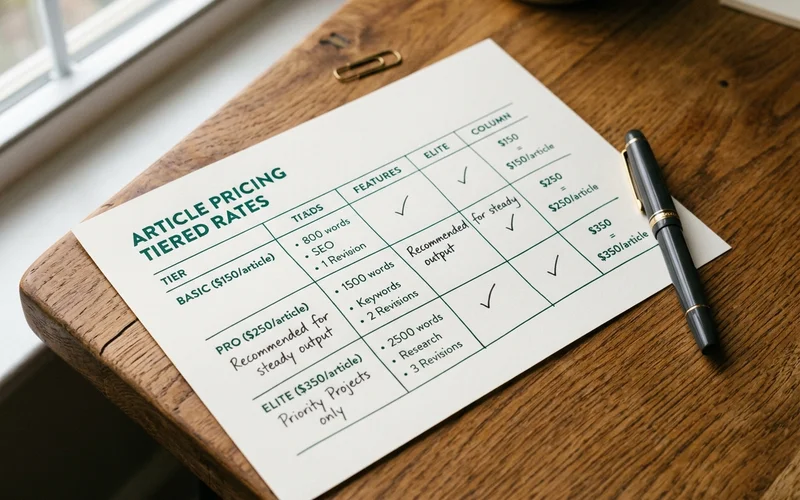
Publishing benchmark rates was the decision I got the most pushback on. The argument against is that it removes room to negotiate and invites comparison.
That is exactly the point. Buyers deserve to compare, and a business that cannot survive comparison has a different problem. Rush is a flat 50% premium, not a number we invent based on how urgent you sound. Retainers at 4, 8, or 12 articles a month carry volume discounts that apply the same way to everyone.
The one thing we will not sell is a rushed version of the 100% human tier. Those eight days are research, interviews, drafting and review. Compressing them means cutting one, and charging a premium for less work is not a product I want to sell.
Where This Leaves a New Client
Start with one 1,000-word article. That is long enough to show whether the research is real and whether the voice matches your business, and it commits you to nothing. If the draft holds up, move to a retainer at volume rates. If it does not, you have spent the price of one article finding out.
Want to see the premium tier? — Read about 100% human-written content
Related service: 100% Human-Written Content
Pure craftsmanship by veteran native journalists for high-stakes brand storytelling and thought leadership.
View Human Writing