
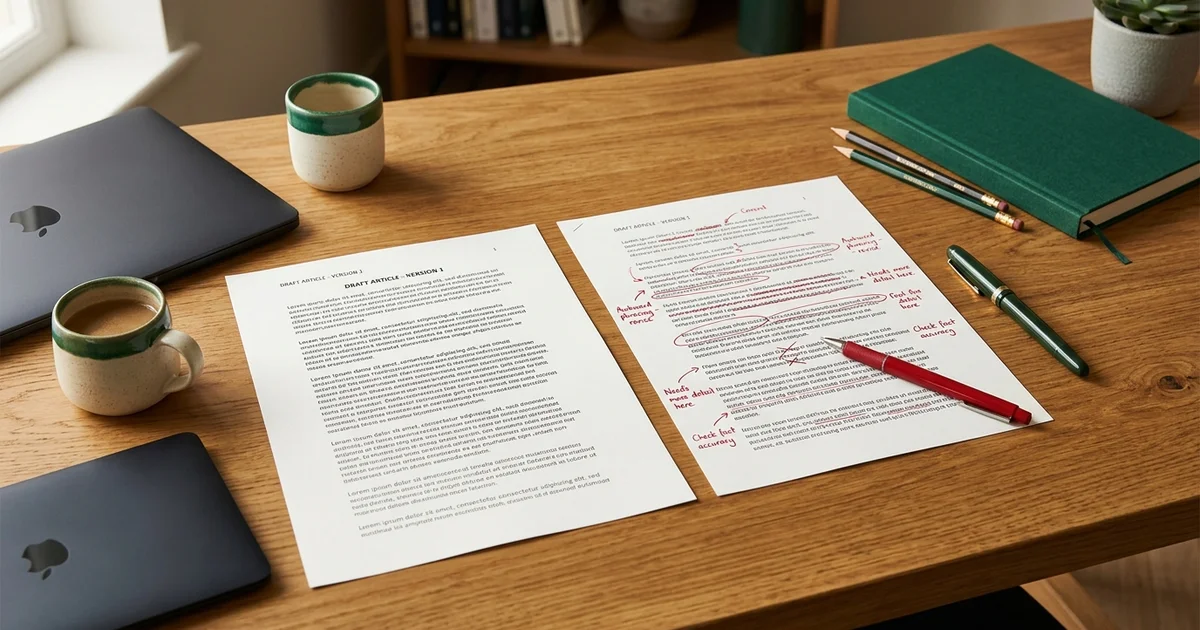
Our team at Content Geeks often hears the same question from business owners scaling their digital publishing. The debate usually centers on the actual value of a human editor when evaluating AI written vs hybrid content. A March 2026 study by Digital Applied tracked 4,200 articles and found that pure automated text ranked 23% lower than human-written pieces.
We interpret this data as proof that editorial rigor determines AI vs hybrid quality outcomes more than the underlying software.
The following breakdown reveals the true financial impact of both production methods. This guide reveals exactly when to rely on automation and when to upgrade to hybrid.
The Comparison
Our production desk handles both tiers using the exact same order form. The real question is whether the fully AI writing tier covers the basic requirements of your page. A professional U.S. content editor currently averages $36.06 per hour according to September 2026 ZipRecruiter data.
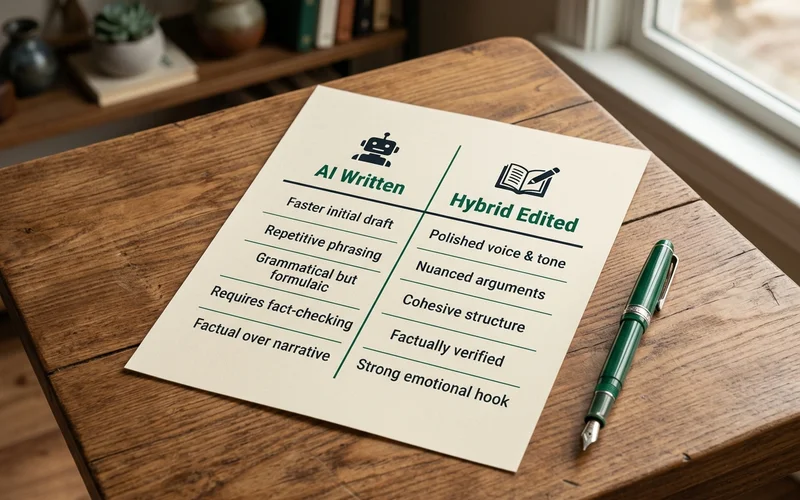
We find that investing in this editorial pass is often the difference between a page that converts and one that simply exists. The table below outlines the core differences between these two approaches. Reviewing these features side-by-side clarifies the AI vs hybrid quality gap.
| Fully AI | Hybrid | |
|---|---|---|
| Rate per 1,000 words | $30 to $80 | $80 to $180 |
| Standard delivery | 48 hours | 5 days |
| Rush | Under 24h (+50%) | 48 to 72h (+50%) |
| Native editor pass | No | Yes, line by line |
| SME fact-checking | No | Yes |
| Brand voice consistency | Prompt-dependent | Enforced by style guide |
| Structural revision | No | Yes |
| Typical rewrite burden for you | Some | Minimal |
Where Pure AI Is Genuinely Enough
We recommend the basic tier when a page focuses entirely on topical coverage rather than customer persuasion. These pages simply need to exist, answer a straightforward question, and provide correct internal links. A 2026 report from BizIQ indicates that automated drafting saves the average U.S. marketer about 6.1 hours per week.
Our workflow relies on automation for these specific, low-risk content types to maximize efficiency. This recovered time translates to roughly $274 in weekly labor value per person. Paying premium human rates for simple definition pages is a massive waste of resources.
We typically assign the following formats directly to the automated tier:
- Glossary and Definition Pages: Short explanations of industry terms.
- Secondary Service Descriptions: Brief overviews of minor service add-ons.
- Routine Informational Content: Simple answers to common, low-stakes questions.
- Supporting Cluster Articles: Pages designed primarily to build semantic relevance.
Where Editing Pays for Itself
The Page Decides an Enquiry
We always mandate human oversight for service pages, comparison pages, and pricing guides. These pages get read carefully by prospects who are very close to making a purchase. Vague phrasing reads as uncertainty, and uncertainty immediately loses the sale.
Our hybrid writing tier earns its higher rate in these high-stakes moments. A 2026 McKinsey study found that strategically edited campaigns generate 32% more conversions than purely automated ones. This massive increase easily justifies the cost of a professional review.
The Claims Carry Risk
We implement mandatory subject-matter expert reviews for anything regulatory, technical, medical, or financial. A confident, incorrect sentence costs significantly more than the initial tier upgrade. The April 2026 AI Index Report from Stanford University revealed that basic models still hallucinate up to 94% of the time on complex queries.
Our team actively protects clients from publishing fabricated medical citations or imaginary legal precedents. Financial monitoring platform ChatFin reported $2.3 billion in Q1 2026 trading losses directly linked to AI-misstated earnings data. The extra cost of an expert editor functions as cheap insurance against catastrophic brand damage.
Your Team Is Rewriting
We track internal revision time because it is the most measurable indicator of a failing content strategy. Fixing a cheap fifty-dollar article for two hours means you actually paid fifty dollars plus two hours of internal salary. The hybrid rate is almost always cheaper than pulling your senior staff away from their actual jobs.
Our production model eliminates this hidden management tax entirely. The initial output arrives polished, fact-checked, and ready to publish immediately. Businesses scaling their local presence can’t afford to bottleneck their growth with endless internal revisions.
The break-even calculation
Hybrid costs about $80 more per article than AI. If a page produces one extra enquiry a year because it reads credibly, it has paid for the upgrade many times over.
Deciding Page by Page
We use a very straightforward sorting rule to organize upcoming content calendars. This framework forces you to evaluate the specific business intent behind every single URL. Assigning resources based on search intent prevents you from overpaying for filler or underinvesting in conversion pages.
- List your upcoming pages: Map out everything you plan to publish this quarter.
- Identify the conversion assets: Mark every page a prospect might read before contacting you. Those go to the hybrid tier.
- Flag the high-risk topics: Mark every page containing a medical, financial, or technical claim you would not want to be wrong. Those require human editing.
- Automate the rest: Everything left over goes to the basic AI tier.
Our clients typically end up with a 60/40 split in favor of automation by volume. The budget allocation usually looks exactly the reverse, with the majority of spend going toward high-quality editing. If you are still unsure which pages belong in the automated bucket, our guide on when fully AI-written content is the right choice works through the qualifying criteria in more detail. A March 2026 ClickRank AI study confirmed that long-term SEO stability requires human-centric pages that satisfy Google’s Experience, Expertise, Authoritativeness, and Trustworthiness (E-E-A-T) guidelines.
The Upgrade Path
We always remind business owners that they are not permanently locked into their first production choice. A smart strategy is to publish informational clusters at the basic tier and monitor their performance in Google Search Console. Analytics data will clearly show which specific URLs are naturally earning impressions and gaining traction over a quarter.
Our content strategists then recommend paying for the hybrid editorial pass on those winning pages. Upgrading proven content ensures you only spend your premium budget where attention already exists. This data-driven upgrade path prevents you from guessing up front and wasting money on pages that never rank.
| Stage | Action | Expected Outcome |
|---|---|---|
| Month 1 | Publish automated content | Establish baseline search visibility |
| Month 3 | Analyze performance data | Identify pages earning organic impressions |
| Month 4 | Apply hybrid upgrade | Increase conversion rates on proven traffic |
We encourage you to audit your current content calendar today. Identify your top three high-value targets, and test the impact of a professional editorial pass this week.