

Two Ways to Decide What a Page Targets
Choosing the right target query is where most local marketing campaigns succeed or fail.
Every order that includes SEO content optimization needs a target query to anchor the strategy. As the team at Content Geeks, we bridge the gap between scalable digital publishing and high-touch editorial quality. The difference between a page that generates leads and one that collects dust comes down to matching what your customers actually type into Google.
When debating client provided keywords vs keyword research, you must prioritize buyer intent over search volume. A 2026 Semrush study revealed that over 88% of AI overview searches are informational, meaning you need precise targeting to capture the buyers. We understand that both homeowners and business owners need immediate returns from their website investments.
This data shapes the entire approach to finding terms that convert. There are two legitimate routes to securing that perfect target keyword, and I will break down exactly how they compare.
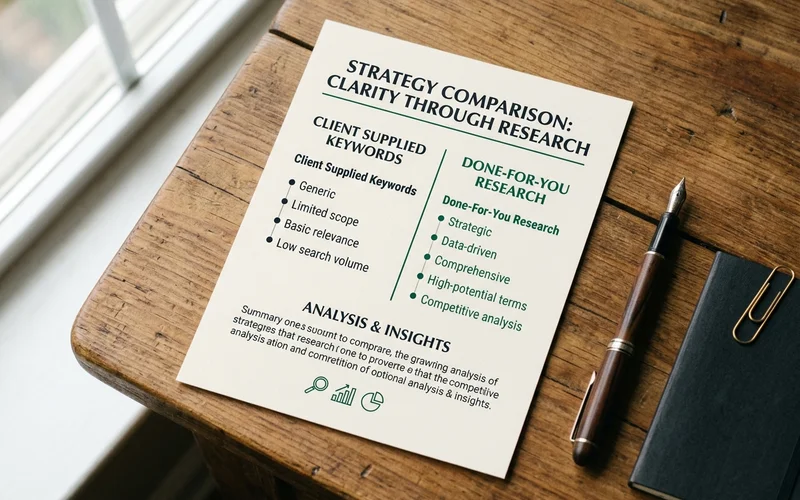
The Comparison
Choosing the right path depends entirely on the resources you currently have available. The comparison below outlines the exact differences between a bring your own keywords approach and letting the experts handle the analysis. We use industry-leading platforms like the Semrush Keyword Magic Tool to conduct these deep dives. This ensures every decision is backed by hard, current data. Industry tools take the guesswork out of the equation for busy professionals.
| Client-supplied keywords | Done-for-you research | |
|---|---|---|
| Added cost | None | $45 per article |
| Added time | None | Delivered with the brief |
| Who picks the target | You | Us, with your input |
| Winnability check | Not included | Included |
| Intent verification | Not included | Included |
| Cannibalization check | Included either way | Included either way |
| Best when | You have a tested strategy | You are starting or stuck |
Whichever route you choose, the on-page deliverables are identical: meta title and description, heading hierarchy, internal link recommendations, and alt text. If you want the research done for you, see unanswered niche keyword research.
When Supplying Your Own Keywords Works Well
Providing a predefined list is incredibly efficient if you already possess a firm grasp of your local market. We happily accept client-supplied lists when you have an established track record. Recent 2026 data from Embryo Agency shows that long-tail keywords account for 70% of all search traffic. Focusing on these specific, multi-word phrases yields higher conversion rates for regional businesses. The production team simply takes your proven data and builds optimized pages around it.
- You already rank for related terms and know exactly what converts for your specific business model.
- An agency or in-house strategist has done the research recently using a platform like Ahrefs.
- You are filling a known gap in an existing cluster to prevent traffic drops.
- The page targets a term customers literally use with you by name during phone consultations.
In these cases, fresh research is merely a duplicate cost. Send the list and the team will implement it immediately, and the page still receives the full on-page treatment described in what is included in on-page SEO optimization.
When Research Earns Its Cost
Starting from scratch without solid data is a massive financial risk for any business owner. We highly recommend this dedicated research service if your current traffic feels stagnant. A 2026 Semrush study found that commercial-intent queries triggering AI overviews grew by 71% in just six months. This massive shift means chasing high-volume keywords without matching specific buyer intent produces traffic that converts to nothing. Targeting the right intent ensures you find terms that actually drive booked appointments.
- Your list came from a tool with the volume filter on. That filter removed exactly the queries most likely to rank quickly.
- You have been publishing and nothing moves. Usually, this is an intent or winnability problem, not a quality problem.
- The terms are broad. “Content marketing” is a category, not a specific, actionable target.
- You are entering a new service or area. No historical data means you have no informed guess to rely on.
- You need pages that produce enquiries this quarter. Research is what finds the low-competition queries that can rank in weeks.
The most common problem in a supplied keyword list
One or two terms that simply cannot be won with the domain authority available. Writing those pages is not a content failure, it is a targeting failure, and it is cheaper to catch before the writing starts.
What We Do Either Way
Two vital checks run on every SEO-tiered order regardless of who chose the keyword. We refuse to publish content that lacks a clear, mathematical path to success. Content must always serve a distinct purpose to rank well.
Cannibalization Check
Keyword cannibalization occurs when multiple pages on your site serve the exact same user intent. We look for existing pages of yours competing for the same query before writing a single word. A 2026 Neil Patel study revealed that mature websites often suffer from nearly 14% keyword overlap, which actively drags down overall rankings. Finding one of these internal conflicts usually explains why neither page ranks, and it takes ten minutes to resolve. The Screaming Frog SEO Spider tools used in our audits verify your URLs are not competing against each other.
Intent Verification
Search intent dictates the exact type of content Google wants to serve to a user. We read what currently ranks to ensure your planned page matches the searcher’s actual goal. Ahrefs categorizes modern search intent into four distinct buckets: informational, navigational, commercial, and transactional. If Google is showing comparison pages and you asked for a local service page, the page type is wrong and the team will tell you immediately. This intent-first approach stops you from wasting money on the wrong format.
Neither check costs extra, because shipping a page that cannot succeed is worse for business than having a transparent conversation. Reach out today to solidify your done for you keyword research strategy and start building pages that actually rank.