

We regularly see US business owners lose sleep over declining search traffic, often assuming a penalty is to blame.
The truth is usually much simpler and completely fixable. A 2026 industry analysis shows that AI search features and outdated information can reduce click-through rates by up to 60%.
Our SEO content optimization service tackles this head-on with a dedicated content refresh seo service. This method revives decaying pages by injecting fresh data and aligning with current search intent. The following guide breaks down why those proven pages lose momentum and how to fix them.
Why Good Pages Decay
We always remind clients that a page ranking well two years ago rarely got worse on its own. Everything around that specific URL simply evolved. The landscape changes in four very specific ways.
- The SERP shifted: Our data shows that Google frequently reinterprets query intent, suddenly favoring comparison lists over your older how-to guide.
- Competitors published better answers: Your article might have been the ultimate resource in 2024, but it is now just the fifth most complete option on the page.
- The data aged: Readers spot a stale figure instantly, and AI engines like Perplexity now heavily favor content updated within the last 13 weeks.
- Entity coverage fell behind: Our editors know that a missing mention of a key 2026 industry shift makes the entire page feel completely abandoned.
These four factors work together to slowly erode your search visibility. The good news is that they are entirely predictable.
The Signs Worth Acting On
We rely on Google Search Console to spot these issues, specifically comparing the last 90 days against the same period last year. The most reliable indicator is a steady, slow decline in clicks that stretches over two or more quarters. You must look past daily fluctuations to find these historical optimization opportunities.
Our team learned to filter out artificial impression drops, like the September 2025 Google update that removed bot-inflated data. That specific change caused impressions to plummet for many US sites while actual clicks remained perfectly stable. The table below outlines the true signals of decay and exactly what they mean for your strategy.
| Signal | What it usually means |
|---|---|
| Position slipping steadily over 2+ quarters | Competitors overtook you on depth |
| Impressions steady, clicks falling | Title and description no longer earn the click |
| Impressions falling on a stable position | Query volume shifted, or the SERP added features |
| Page ranks for a different query than intended | Intent drift, the page needs realigning or splitting |
| Enquiries stopped, traffic unchanged | The content is dated in a way readers notice |
We use this data to quickly decide which pages require immediate attention. Catching these trends early prevents a minor dip from becoming a permanent traffic loss. A proactive approach saves countless hours of recovery work later.
What a Refresh Involves
We break the refresh process into four distinct stages, always prioritizing changes that deliver the highest impact.
- Intent realignment: You must re-read what currently ranks, because if the SERP now favors comparison pages and yours is a tutorial, nothing else you tweak will matter.
- Data updates: Anything that cannot be re-verified through a current web search gets removed rather than quietly left in.
- Entity insertion: Our researchers follow this step by using tools like Clearscope or Ahrefs to add the terminology that entered the topic since publication.
- On-page polish: This final stage requires writing accurate alt text for any newly added images and updating the heading hierarchy.
A 2026 Orbit Media survey found that bloggers who rigorously update older posts are 2.5 times more likely to report strong results. We always remind clients that the existing URL must remain exactly the same throughout this entire process.
You must keep the original URL exactly as it is. The existing address carries backlinks, internal links, and accumulated ranking signals. We see sites discard all three for absolutely no benefit when they republish at a new address.
Refresh or Replace?
The decision to refresh or replace depends entirely on the current state of the page. The core subject must still be relevant to your current business goals before you invest any time.
We generally use these specific criteria to make the final call:
- When to Refresh: A refresh makes sense when the page still has existing rankings, backlinks, or internal links pointing at it.
- When to Replace: Complete replacements are necessary only when the page targets a query you no longer care about.
- When to Consolidate: Our strategists recommend merging pages when two of your articles compete against each other for the exact same term.
Consolidation remains an incredibly underrated tactic for cannibalizing pages. This approach funnels all the historical authority into a single, highly optimized destination.
We frequently find that merging two thin posts into one strong guide with a 301 redirect outperforms trying to improve either one individually. It instantly clarifies your site structure for search engines. This clarity also helps local customers find exactly what they need faster.
Realistic Outcomes
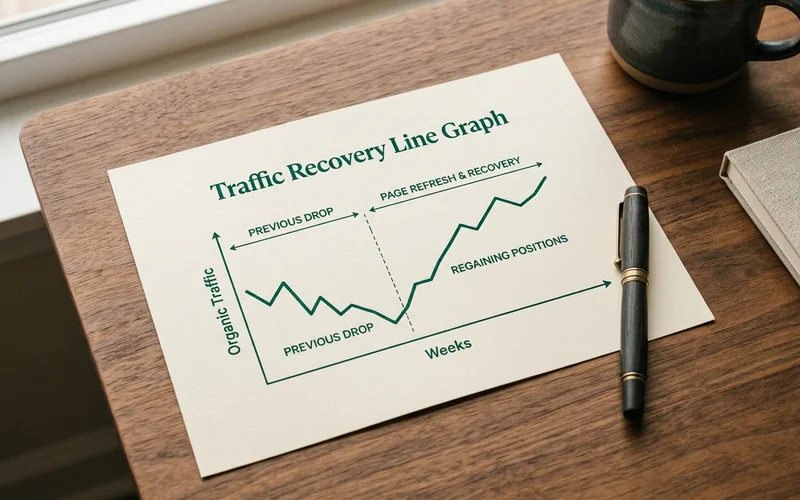
We typically see noticeable movement within four to eight weeks after deploying a well-executed update old blog posts seo strategy. Pages that slipped simply because competitors added more depth are the most reliable and fastest to recover. A major HubSpot case study showed that updating old posts with new content and images can increase organic traffic by 106%.
Our experience with structural fixes takes a bit longer, depending entirely on how drastically the SERP shifted. What a refresh cannot do is rescue a page targeting a keyword you were never going to win in the first place. That scenario is a targeting problem, and the solution lies in understanding what makes SEO content rank rather than doing another editing pass.
We encourage business owners to view this content refresh seo service as an ongoing investment rather than a one-time project. Consistent updates protect your digital real estate from aggressive competitors. Start by reviewing your top five declining pages today and plan your first strategic refresh.