

Three Things Decide Rankings
Strip away the tactics and ranking comes down to three questions Google is trying to answer about your page.
- Does this page match what the searcher actually wanted?
- Does it show genuine expertise and experience?
- Does the site cover this subject properly, or is this a one-off page?
Everything else, including most of what gets sold as SEO, is in service of those three. Our unanswered niche keyword research exists to answer the first one before a word gets written.
1. Search Intent: Answer the Question Asked
Search intent is what the person actually wanted when they typed the query. There are four common types.
| Intent type | The searcher wants | Content that fits |
|---|---|---|
| Informational | To understand something | Explainers, definitions, how-to guides |
| Commercial investigation | To compare options before buying | Comparisons, cost guides, what-to-expect pages |
| Transactional | To buy or book now | Service pages, pricing, contact |
| Navigational | A specific site or brand | Homepage, branded pages |
The most common ranking failure we see is an intent mismatch: a business writes a sales page for an informational query, or a 2,000-word explainer for someone who wanted a price. Check the current results before writing. Whatever Google is already showing is the clearest available statement of what it thinks the intent is.
2. E-E-A-T: Show That Someone Knowledgeable Wrote It
E-E-A-T stands for experience, expertise, authoritativeness and trustworthiness. It is not a score you can see, but the signals are concrete.
Experience looks like first-hand detail. The specific thing that happens on the third visit, the permit that always takes longer than clients expect, the mistake people make in month two.
Expertise looks like correct terminology used naturally, appropriate qualification of claims, and knowing which caveats matter.
Authoritativeness looks like a named author with real credentials, deep citations, and other credible sources referencing the page.
Trustworthiness looks like accurate information, visible contact details, honest pricing, and no claim you cannot support.
The practical test for E-E-A-T
Could a competent generalist have written this page from search results alone? If yes, it lacks experience signals. The fix is a subject-matter expert, not more words.
3. Topical Authority: Cover the Subject, Not the Keyword
A single page on a subject reads as an opinion. Twelve connected pages covering the subject properly read as a resource.
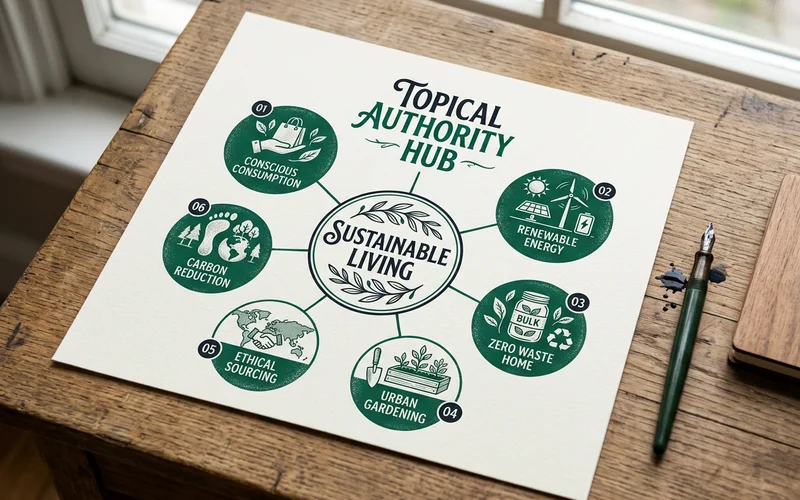
Topical authority is built with clusters: a hub page targeting the main commercial term, surrounded by support pages answering the questions people ask on their way to it, all linked together. The hub links to the spokes, the spokes link back, and the cluster ranks as a unit.
This is why publishing cadence matters less than cluster completion. Finishing one cluster beats starting three. If you are trying to translate that into a monthly plan, how many blog posts per month a business needs to rank puts realistic numbers against it.
How This Maps to Content Tiers
Each of the three factors has a different cost profile, which is why the tier you choose should follow the page’s job.
Fully AI writing can satisfy intent and cover topics. It cannot generate genuine experience signals, because it has none. Use it for breadth in a cluster where the stakes are low.
Hybrid writing adds a native editor who can enforce intent match, fix the structure, fact-check claims, and add the specifics that read as expertise. This is the right default for most commercial pages.
100% human writing is where original research, source interviews, and a credentialed author produce the experience and authoritativeness signals that competitive queries demand.
On-page fundamentals sit underneath all three. Our on-page SEO optimization package handles the meta title and description, heading hierarchy, internal linking, and alt text so the signals you built actually get read.
None of this is a trick. Rank well by answering a real question better than the current results, with someone credible behind it, on a site that covers the subject. The rest is implementation detail.