

We hear business owners ask how many blog posts per month to rank their websites every single week.
The exact number depends heavily on your local US market and specific industry competition. A 2026 study by HubSpot shows that companies publishing 16 or more posts per month generate 4.5 times more leads.
Our team at Content Geeks bridges the gap between scalable digital publishing and high-touch editorial quality to create a sustainable plan for your specific business. Quality and consistency will always beat a sudden burst of poorly planned content. Let’s look at the data, what it actually tells us, and then explore practical ways to respond.
How Many Blog Posts Per Month to Rank? The Honest Answer
We always start with a direct answer: your ideal frequency depends entirely on competition and the amount of unclaimed topical ground. There is no universal number, and any agency selling a fixed package without asking about your niche is skipping the actual strategy. A 2026 report from First Page Sage found that the consistent publication of satisfying content now accounts for 23% of Google’s ranking algorithm.
Our team uses this data to emphasize that content velocity is about building momentum, not just hitting an arbitrary quota. Many home service businesses, like local roofers or HVAC technicians, can win their market with just a few well-crafted pages each month. A 2025 LeadG2 industry report noted that comprehensive articles between 1,500 and 2,000 words tend to perform best in search results.
We structure our client roadmaps around this exact philosophy of prioritizing depth over sheer volume. You will get much better results from two thoroughly researched articles than from ten short, unhelpful updates. The ranges below hold up across most of the businesses that need to understand content velocity.
Our advice is to pair these benchmarks with the tier logic in hybrid content writing so the cadence becomes a clear budget question rather than a wild guess. This approach allows you to plan your marketing spend with complete confidence. The table outlines what different publishing speeds can practically achieve for your brand.
| Business situation | Realistic cadence | What it buys |
|---|---|---|
| Single-location local service | 2 - 4 posts / month | Covers core service questions and local queries within two quarters |
| Multi-location or multi-service | 4 - 8 posts / month | Builds one full cluster per quarter without thinning quality |
| Competitive niche or new domain | 8 - 12 posts / month | Enough topical depth to compete where authority is already established |
| Maintenance after cluster completion | 1 - 2 posts / month | Refreshes and fills gaps as the SERP shifts |
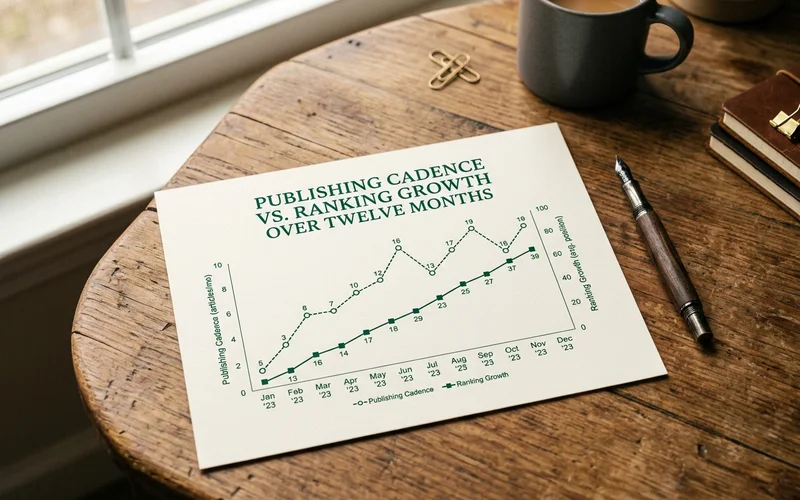
Content Velocity vs. Realistic Timelines
We define content velocity as the rate at which you cover a specific topic space, not simply the rate at which you publish words. Eight thin posts scattered across unrelated subjects produce significantly less value than four comprehensive posts that complete a single cluster. A 2026 digital marketing report from SmartScalInsights confirms that new blog posts typically require 3 to 6 months to generate meaningful organic traffic.
Our experience shows that impatient business owners often abandon their strategy right before this compounding growth actually begins. Patience and strategic internal linking are absolutely critical to seeing a return on your marketing investment. Completed clusters rank as a cohesive unit.
We rely on a practical publishing sequence that works for every local market.
- First, pick one service or topic cluster. Trying to cover three topics at once dilutes your focus.
- Our teams always publish the main hub page first. Next, publish the support pages that answer the exact questions buyers ask on the way to that hub.
- Link everything properly. We ensure the hub links to the spokes and the spokes link back to the hub.
- Finish the entire cluster before starting the next one. Half-finished clusters simply rank as isolated, weak pages.
We see businesses publish twelve times a month across scattered topics and wonder why nothing moves. A disciplined approach prevents this wasted effort. This brings us to a fundamental truth about SEO.
We always tell our clients to prioritize steady growth over erratic publishing.
Consistency beats bursts. Four posts a month for six months completely outperforms twenty-four posts in one quarter followed by total silence. Our analytics show the second pattern looks like a short-lived campaign. The first pattern looks like a healthy, actively maintained site.
Search engines specifically look for this type of ongoing maintenance.
Start With One Article, Not a Cadence
We highly recommend running a single 1,000-word test article before committing to any monthly number. A baseline of that length provides enough space to demonstrate topical depth and ranking potential. This initial test also confirms whether the writing voice accurately matches your specific business identity.
Our content strategists suggest using Google Search Console to monitor how quickly this first piece gets indexed.
- Fast indexing on a test piece indicates your domain already has decent authority in that specific subject area.
- Sluggish indexing means you will need to build foundational topic clusters before expecting massive traffic.
We find that once you have seen the actual output, the retainer decision gets incredibly easy. Monthly retainers of 4, 8, or 12 articles generally secure discounted volume rates from professional agencies. The tier mix is entirely yours to set, allowing you to use AI for basic support content and human writers for crucial money pages.
Our SEO content writing cost guide breaks down exactly what each unique mix runs. Reviewing those numbers helps you align your marketing budget with realistic growth expectations. Smart financial planning prevents the common mistake of abandoning a campaign halfway through.
How to Choose Your Number
We always ask clients to answer three distinct questions to determine their final number. These questions remove the guesswork and provide a mathematically sound publishing schedule. Tools like Ahrefs or local Reddit community threads can help uncover additional questions your competitors are ignoring.
- Our process starts by asking: How many unanswered questions exist in your specific space? If your sales team answers the same twenty questions on the phone every month, you clearly have twenty pages worth writing. A distinct finish line immediately appears when you document these common customer inquiries.
- We then ask: How fast do you actually need coverage? Dividing your total topic cluster size by your target completion window gives you the exact monthly cadence. Twenty pages spread across two quarters equals roughly three optimized posts a month.
- We finish with the most important consideration: What pace can you realistically sustain? A massive cadence that you abandon after three short months does far more harm than a smaller one you keep running. Google’s algorithms heavily reward consistent, reliable updates over sudden, erratic publishing spikes.
We strongly advise picking a realistic number you can comfortably fund for an entire year.
Proper planning ensures your marketing engine never stalls out due to budget constraints. A sustainable approach always yields the best long-term return on investment.
Our niche keyword research service can map this entire cluster out for you from start to finish. This process directly turns your buyer questions into a highly prioritized page list. Knowing exactly how many blog posts per month to rank becomes incredibly simple once that comprehensive map is built.
We invite you to reach out for a custom content audit today. A quick consultation will help clarify your next steps. Your path to dominating local search starts with a single, well-planned strategy.