
We built Content Geeks to bridge the gap between scalable digital publishing and high-touch editorial quality. You probably already know that showing up in the Google Map Pack is critical for driving real foot traffic and phone calls. First Page Sage data from 2026 shows that the top three map pack spots capture a combined 48% of all page clicks.
Those clicks translate directly into revenue for your business.
Let’s look at the data, what it is actually telling us about local ranking factors, and then explore practical ways to respond. Our strategy breaks down how local blog content and your Google Business Profile work together, outlining the exact publishing cadence that moves the needle.
What Local Content Can and Cannot Influence
Local-pack ranking rests on three fixed pillars: relevance, distance, and prominence. We know that exactly 46% of all Google searches carry local intent, meaning nearly half of your potential customers are looking for nearby solutions. The core ranking factors break down like this:
- Distance is fixed and completely tied to your physical location. No amount of content moves your address closer to the searcher.
- Relevance is how well your business matches what was searched. Content directly influences this factor by demonstrating that you actually perform a specific service in a designated area. A 2026 Whitespark study confirms that exact-match relevance and specific service categories are primary drivers of map visibility.
- Prominence is how well known and well regarded your business is across the web. Content contributes to this through citations, inbound links, and the general depth of your local digital footprint.
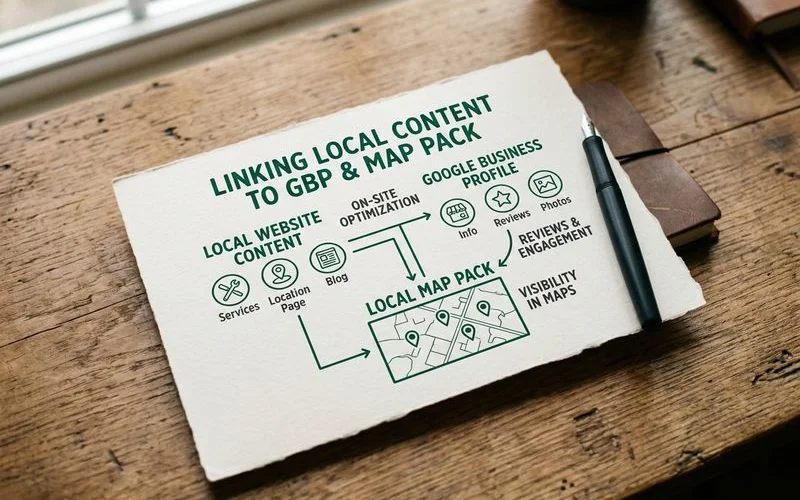
We treat your site and your Google Business Profile (GBP) as a unified system because two of these three ranking factors respond directly to publishing. This unified approach is exactly why our local SEO content writing program exists. Every localized article you publish acts as a supportive piece of map pack ranking content for your listing, which works best when those articles sit inside a deliberate local pillar-and-spoke content structure rather than accumulating at random.
How the Two Reinforce Each Other
Your on-site articles and your Google Business Profile act as a continuous feedback loop. We have seen that businesses with complete, actively managed profiles and supporting content earn up to seven times more clicks than partial profiles, according to 2026 search benchmarks.
Google constantly assembles a picture of which businesses genuinely operate in specific neighborhoods. Every consistent, localized signal sharpens that picture for the algorithm.
| On-site content does this | Which supports GBP by | Real-World Impact |
|---|---|---|
| Publishes area-specific service detail | Confirming genuine service-area relevance | Filters out generic competitors |
| Answers local questions in depth | Giving GBP posts and Q&A somewhere useful to link | Boosts profile engagement metrics |
| Maintains consistent NAP details | Strengthening citation consistency | Prevents algorithm confusion |
| Builds a service-area page per location | Matching the areas listed in your profile | Validates your service radius |
| Earns local links and mentions | Contributing to prominence | Increases authority and trust |
Our team relies on this exact framework to build topical authority for local markets. The connection is highly logical rather than mystical.
What to Actually Publish
You must avoid general industry posts with a city name simply dropped into the title. We strongly recommend publishing things that could only have been written by an expert working in your specific town.
A 2026 BrightLocal consumer survey found that 62% of shoppers avoid businesses with outdated or incorrect online information. Your content must be accurate, timely, and hyper-relevant to your actual service footprint.
- Local regulation and permit explainers. Document what the process looks like in your specific jurisdiction, such as the exact building permit timelines in Cook County.
- Seasonal and condition-specific pieces. Explain what goes wrong in your area, like frozen pipes during sudden New England cold snaps or HVAC failures in peak Texas summers.
- Project write-ups. Detail a real job in a named neighborhood, outlining the specific problem, the local constraint, and the successful outcome.
- Answers to local questions. Address the specific things your field technicians get asked in your immediate service area and nowhere else.
- Local comparison pieces. Review the options available in your specific market, highlighting honest trade-offs for local buyers.
The single best source of local content ideasThe last twenty questions your field team was asked on site. They are specific, local, and almost certainly unanswered online.
Our strategists constantly use this exact question-gathering method to find untapped topics. Field data provides the raw material for content that actually converts.
Cadence and Linking
Publishing one to two genuinely local pieces a month is entirely sufficient for most single-location businesses. Multi-location operations should rotate coverage rather than trying to publish for every area every month.
We advise clients to execute a specific internal linking loop for maximum impact. You can establish this structure by following two steps:
- Link each new article into the matching service-area page using descriptive anchor text.
- Link the service-area page back out to your most useful supporting articles.
This bidirectional linking turns a standard blog into a structural support layer for the pages that actually convert.
Your next step is using your GBP posts to surface these new articles directly on your profile. We know that the top spot in the Google Map Pack alone captures 17.6% of all page clicks based on 2026 First Page Sage data. A post summarizing a local explainer gives your profile the fresh activity required to compete for that position.
Finding the Queries Worth Writing
Local questions are the absolute clearest example of queries that report zero search volume but convert at an incredibly high rate. Somebody searching for a specific HVAC permit question in Maricopa County is not casually browsing.
We constantly see these hyper-specific, long-tail phrases outperform generic terms. A 2026 analysis of zero-volume local keywords revealed that these highly targeted queries boast average conversion rates exceeding 36%, simply because they address an immediate, precise need.
This precise targeting is why unanswered niche research exists to surface exactly these hidden opportunities. You can capture these high-converting queries by taking two immediate steps:
- Document the specific questions your field team answers on site every day.
- Turn those exact questions into localized articles for your website.
Our team relies on this exact formula to help businesses dominate their local map pack. Take a hard look at your current GBP content strategy today, and start publishing the answers your customers are actively searching for.