

You know how frustrating it is to invest in a website only to see local competitors dominating the map pack.
We hear this constantly from business owners trying to expand their service areas. The team at Content Geeks bridges the gap between scalable digital publishing and high-touch editorial quality to solve this exact issue.
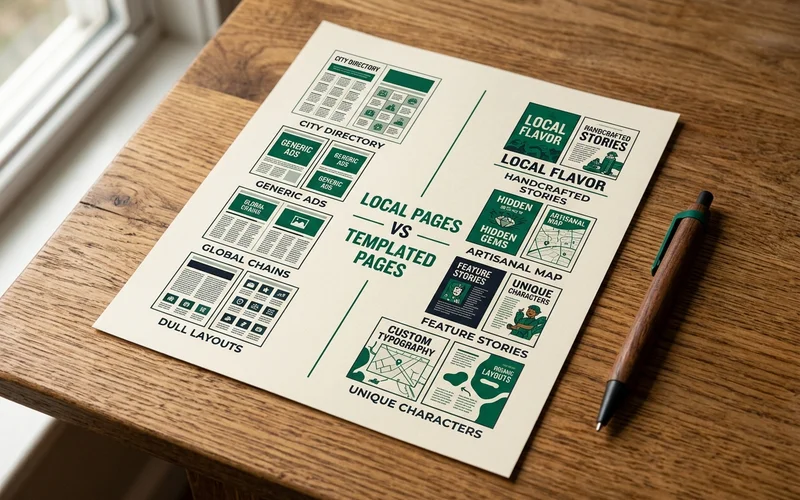
The common culprit is usually a messy approach to multi location city pages duplicate content.
Let’s look at the data behind why these pages fail and explore a few practical ways to fix them.
What Actually Happens With Templated Pages
Google rarely issues a dramatic manual penalty for these pages. The search engine simply evaluates twenty near-identical pages, concludes they add little unique value, and ignores the rest.
We see companies end up with twenty URLs in their sitemap, a handful of impressions, and a strong suspicion that local search does not work. The overall site structure was never the primary problem. The sameness of the text was the issue.
Our local SEO content writing service exists because the fix is straightforward and almost nobody does it. You must write each page about the actual place.
We rely on 2026 data from BrightLocal, which shows businesses with genuinely optimized local landing pages are 2.8 times more likely to appear in the Google Local Pack. This massive difference in visibility proves that distinct usefulness wins.
Recent algorithm updates in 2025 and 2026 specifically target these thin location pages. Research from PBJ Marketing shows that cloning templates creates massive keyword cannibalization.
We advise clients to avoid this because multiple identical pages end up competing against each other for the same search term. Search engine bots also waste your crawl budget indexing clones instead of your important service pages.
To make matters worse, AI search engines like Perplexity and Google’s AI Overviews actively skip duplicate templates because they lack original citations. We use a simple table to show the real-world impact of this duplicate content trap.
| SEO Metric | Templated City Page | Genuinely Local Page |
|---|---|---|
| Local Pack Likelihood | Low visibility | 2.8x Higher |
| Crawl Budget Impact | Wastes resources | Efficient indexing |
| AI Overview Inclusion | Actively skipped | Highly likely |
The Find-and-Replace Test
Take any two of your location pages and compare them side-by-side. If the only differences are the place names, you have a template instead of actual content.
We always recommend using the Flento Unique Page Test developed in 2026 to audit your site.
- Swap the name: Replace your target city with a completely different town.
- Check the flow: If the page still reads perfectly, your content is too generic.
- Verify the word count: You need a minimum of 500 words of genuinely unique body content to stop the duplicate filter.
A resident of that area should be able to tell the page was written about their neighborhood without reading the place name. If a user cannot recognize their own town, the page has no local relevance to offer. Local relevance is the only thing this page was built to demonstrate.
We often see HVAC or roofing companies make the common mistake of using the exact same paragraph order across twenty different cities. This strategy completely fails modern AI answer engines.
The uncomfortable implication
If you cannot write genuinely local content about an area, you probably should not have a page for it. That is a strategy answer, not a writing answer.
What Genuine Local Substance Looks Like
Genuine local substance requires specific, verifiable facts about a region that cannot be copied to another town. You must include details that only a resident or local worker would know.
Our editorial team identifies six sources of detail that cannot be templated.
- Named neighborhoods and landmarks. Do not just target the greater metro area in your text. Mention the specific districts, streets, and developments you work in, like serving Buckhead in Atlanta rather than just Georgia.
- Building stock and property types. Pre-war walk-ups require different tools than 1970s ranch homes or new-build estates. Each creates different jobs, distinct access problems, and unique customer questions.
- Regulatory and permit realities. Jurisdictions differ heavily on inspections, permits, and timelines. Knowing that Chicago electrical permits differ drastically from Naperville regulations is a strong expertise signal.
- Access and logistics. Parking restrictions in downtown Boston differ from suburban driveways. Mention narrow streets, service entrances, and seasonal access issues to provide practical proof.
- Seasonal patterns. What goes wrong in a snowy market in February differs wildly from a humid market in July.
- Local customer questions. Customers in one area always ask about one thing, while customers in another area ask about something else. For example, RedBrick Web Solutions noted in 2025 that Atlanta homeowners constantly ask about hard water buildup.
We know that adding this localized proof builds immediate trust. You should integrate regional reviews, embedded Google Maps, and photos of local jobs.
The Writing Approach That Works
The most effective writing approach starts with interviewing your field team to gather real local details. You must build each page independently using these grassroots insights.
We use a strict five-step process to ensure quality across every location.
- Interview your field team. Twenty minutes with whoever actually works in each area produces more usable local detail than a day of desk research.
- Write each page independently. Do not use a template with slots. Starting from the local material rather than the boilerplate is the single biggest structural change you can make.
- Keep a shared spine, vary the substance. The page can follow the same section order across areas, but the content inside those sections must be genuinely different.
- Link each page to the service pillar. Use descriptive anchor text and follow the pillar-and-spoke structure. This structure funnels authority from your primary domain down to specific service areas.
- Cut the areas you cannot support. Seven strong pages always beat fifteen weak ones. The strong ones will actually rank and generate leads.
We highly recommend using a tool like Yext or Whitespark to ensure your location page details match local directories exactly. Consistent Name, Address, and Phone data prevents search engine confusion.
PipelineOn Research published 2026 data showing that 91 percent of consumers read local business reviews before contacting a business. We pair those specific, localized reviews to our seven strong pages to maximize conversion rates.
Top map pack rankers require a minimum velocity of four to five new reviews per month tied to those locations.
A Reasonable Standard to Hold
Each location page should contain at least three specific facts that would be false if you copied them to the next town’s page. This three-fact minimum is a low bar that most templated pages cannot clear.
We use this rule to guarantee every piece of content earns its place. If your pages can pass this test, you do not have a duplicate content problem. You have a set of highly relevant pages that the Google map pack rewards.
We see artificial intelligence engines aggressively filtering out weak city pages today. Tools like Perplexity actively look for distinct usefulness before citing a local business.
- AI Overview Checks: Models skip indistinguishable pages because they lack original citations.
- Map Pack Rewards: Google actively ranks pages that pass the three-fact minimum rule.
We encourage you to audit your site today.
Improving your location page seo requires a commitment to genuine, verifiable facts.
Fixing your city page duplicate content is the fastest way to restore your local search visibility and start capturing more regional leads.