
Many business owners know that clicking a button in ChatGPT will not instantly solve their marketing problems.
A 2026 Ahrefs study found that while AI-generated pages can rank, pages relying heavily on AI index less often and earn fewer impressions. Our team consistently sees this data play out in real-world campaigns.
This gap between raw output and helpful content is exactly what you must manage. So, I will break down the options in this ai vs hybrid vs human content guide and show you exactly which content tier to choose for your specific website needs.
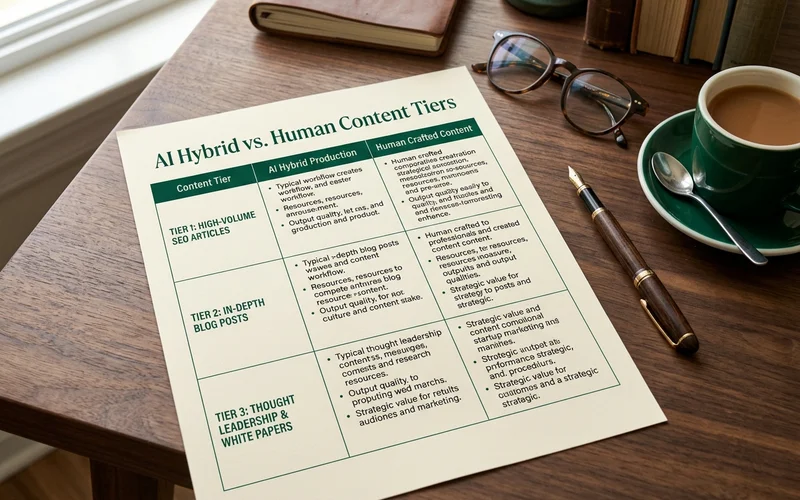
The Comparison in One Table
All three tiers are built by the same desk on the same order form. The real difference lies in how much human judgment each page receives before publishing.
Our workflow at Content Geeks bridges the gap between scalable digital publishing and high-touch editorial quality. This means every asset follows a strict production standard. A 2026 Adobe survey of US marketers shows 75% use AI to save organizational costs, but those savings disappear if the resulting pages fail to convert.
| Fully AI | Hybrid | 100% Human | |
|---|---|---|---|
| Rate per 1,000 words | $30 - $80 | $80 - $180 | $180 - $400+ |
| Standard delivery | 48 hours | 5 days | 8 days |
| Rush available | Yes, under 24h (+50%) | Yes, 48 - 72h (+50%) | No |
| Who produces it | Engineered prompt workflow | AI draft, native editor rewrite | Veteran journalist, from scratch |
| Fact-checking | None | SME pass | Primary sources and citations |
| Original research | No | Limited | Yes, including interviews |
| Best for | Volume topic coverage | Most commercial content | High-stakes, original argument |
Our hybrid writing tier is the default recommendation for most clients. The rest of this guide explains exactly when that middle path is not the right choice.
The Decision Rule: What Does the Page Risk?
Forget the tier names for a moment and ask yourself what happens if the page is merely adequate. Evaluating the risk of a specific URL provides a direct answer within seconds.
Nothing happens. Perhaps it is a supporting article covering a niche subtopic just so your SEO cluster is complete. Nobody is making a major purchasing decision based on it. You can confidently use fully AI writing and spend the savings on broader coverage.
A prospect loses confidence. The URL might be a core service page, a product comparison, or a local landing page that someone reads right before calling your office. Generic phrasing and a wrong detail will cost you the enquiry. You should use hybrid here because Google’s 2026 core update documentation heavily penalizes unhelpful text while rewarding pages with clear user intent.
Your credibility takes a hit. The page carries your personal name, states a bold industry position, or makes claims a customer or regulator could challenge. You absolutely must use 100% human writing for these assets. Neil Patel’s 2026 tracking data shows that human-written articles averaged 283 visits per post by month five, heavily outperforming automated text when long-term trust is required.
That single question resolves most tier decisions faster than staring at a feature comparison chart. If the middle tier is where you expect to land, what is hybrid AI + human content writing explains exactly what the editor does to a draft before it reaches you.
A rough budget heuristic
If the page could plausibly generate one enquiry a month, the difference between the AI and hybrid rate is recovered in the first enquiry. If it cannot, it probably does not need the hybrid rate.
Speed as a Deciding Factor
Sometimes the project schedule picks the production tier for you. Deadlines often force a compromise between turnaround time and deep research.
The AI tier runs 48 hours standard, or under 24 hours with rush delivery. Hybrid runs five days normally, shrinking to 48 to 72 hours with a rush order. The human tier runs eight full days and cannot be rushed at any price, because the deep research and expert review are the actual product you are buying.
Our production schedules are built to reflect reality. Peak Freelance’s 2026 market survey found the most popular price for a 1,500-word human-written blog post is $250 to $399, but those solo writers often carry a waitlist of two to three weeks. This setup eliminates that unpredictable wait time while maintaining high editorial standards.
Balancing Time and Quality
- Urgent Campaign Launches: If you need something tomorrow for an email blast that goes live next week, hybrid rush is usually the best quality available inside that tight window.
- High-Volume Requirements: If you need twenty category pages before quarter end, the AI tier is the only option with the required throughput.
- Strategic Assets: If you are publishing a flagship industry report, you must wait the eight days for a human writer.
Semrush’s April 2026 industry survey found that 64% of SEO professionals now rely on a hybrid workflow specifically to solve this exact tension between rapid deployment and quality control.
What Each Tier Cannot Do
Being specific about production limits is much more helpful than just listing a bunch of features. Understanding what breaks the system will save you money.
Fully AI cannot generate genuine experience signals, verify its own claims, or hold your brand voice across a large set of pages. It will produce fluent, average, and occasionally wrong text very quickly. Loopex Digital’s 2026 data shows US marketers using AI report a 37% drop in customer acquisition costs, but that efficiency vanishes if you use bots for tasks requiring deep subject matter expertise.
Hybrid cannot conduct primary research or interview your internal subject-matter experts. The human editor drastically improves the machine draft, but they are not acting as an investigative reporter.
100% human cannot be delivered in 48 hours, and it cannot be justified on budget grounds for routine, low-risk content. Paying premium journalist rates for basic FAQ pages is a massive waste of resources.
The Credibility Factor
A 2026 empirical research study published in MDPI identified a phenomenon called the algorithm discount. Consumers significantly reduce their trust and sharing intentions when they suspect high-stakes claims lack human verification. You must assign your tiers based on the trust required for the reader to take action.
The Mix Most Clients Settle On
After running an initial test project, most businesses land somewhere close to a standardized ratio. Ahrefs’ July 2026 ranking analysis found that while fully AI pages occasionally hit the top spots, pages with mostly human intervention accounted for 82.2% of top-three rankings. This highlights why a blended approach is essential.
Here is the allocation breakdown we typically see across successful portfolios:
- 50 to 60 percent of volume at the AI tier. This covers the massive breadth of a topical cluster where speed matters most.
- 30 to 40 percent at the hybrid tier. This secures your core service pages, local competitor comparisons, and absolutely anything a prospective buyer reads before pulling out their credit card.
- 5 to 10 percent at the 100% human tier. This protects your flagship industry reports, strong opinion pieces, and executive thought leadership.
Start with one 1,000-word test article at the tier you think you need right now. The resulting draft will tell you much more about the right production mix than staring at another content tier comparison ever could. If you are ready to stop guessing and start scaling a smart strategy, reach out to our team today to request your first test project.