

The Short Definition
We constantly hear from business owners asking exactly what is hybrid AI content writing and why it costs more than raw software output. That frustration with pricing and quality makes perfect sense.
Our team at Content Geeks bridges the gap between scalable digital publishing and high-touch editorial quality. You see, 2026 data shows that 84% of US small businesses use AI for marketing. The real challenge is turning those automated drafts into something a customer actually wants to read.
Let’s look at the data, clarify what AI plus human writing involves, and show how our hybrid AI and human content writing framework keeps your standards high.
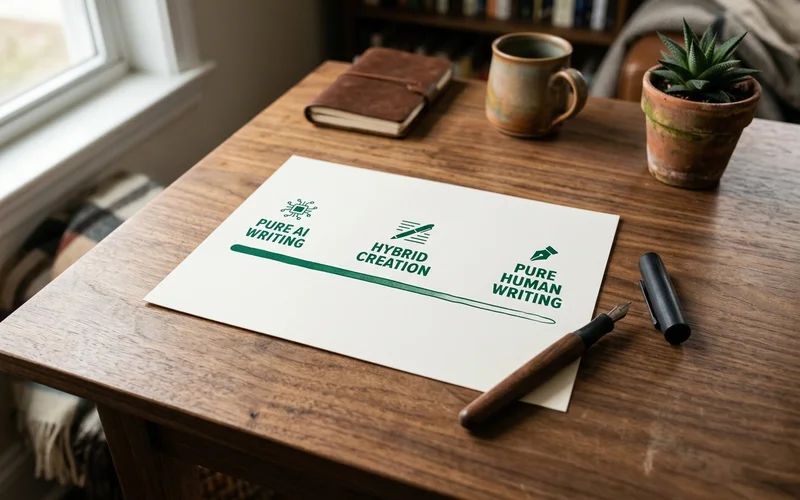
This blended approach means an AI model produces the first draft, and then a native English editor rewrites it line by line before delivery. Both halves are completely necessary. The human editing phase is where your money goes.
We price this tier at $80 to $180 per 1,000-word article with a standard five-day delivery. This cost shifts depending on whether you take the SEO package. Compare that to the $0.42 to $1.25 per word average that fully human freelance writers charge in the US right now.
You get professional AI assisted content without the premium price tag.
How the Two Halves Work Together
We divide the workload based on the specific strengths of each party. The AI pass handles structure, breadth, and speed. A prompt-engineered Large Language Model like ChatGPT or Claude will produce a complete draft in minutes. This initial pass covers the expected subtopics based on search intent.
Our editors then step in to fix what the software breaks. Models often struggle with context and accuracy. The Stanford AI Index for 2026 reveals that AI platforms hallucinate between 22% and 94% of the time on hard factual questions.
This high error rate requires a heavy human touch. Concretely, the editor:
- Rewrites for voice, rhythm, and idiom appropriate to your market
- Cuts or merges the sections the model padded
- Replaces generalities with the specific details a practitioner would use
- Applies the editorial rubric and your style guide so terminology stays consistent
- Runs Subject Matter Expert fact-checking on statistics and technical claims
- Screens for originality using tools like Copyscape before delivery
We know that a fast draft is useless if it damages your brand credibility. MIT researchers found in 2026 that AI models are 34% more likely to use confident language exactly when they are generating incorrect information. The output you receive is never just an AI draft with typos fixed. It is a completely rewritten piece that used an AI draft as scaffolding.
A useful way to think about it
The AI writes the version that covers the topic. The editor writes the version a customer would believe.
Where Hybrid Sits Between the Other Two Tiers
We price and position the hybrid tier squarely between cheap software automation and expensive freelance retainers. A completely human-written 1,000-word piece from a specialist writer often exceeds $400. Raw output from software like Jasper might cost just a few dollars but requires hours of your own time to format and verify.
Our hybrid approach hits the sweet spot for budget and quality. Mid-market marketing teams tripled their AI tool spending to an average of $3,400 a month in 2026. Companies are desperate for volume, but they still need human oversight to avoid publishing embarrassing errors.
You should reserve the fully human tier for high-stakes thought leadership. Never use raw AI for pages that offer medical, financial, or legal advice.
| Fully AI | Hybrid | 100% Human | |
|---|---|---|---|
| Who writes | Model, prompt-engineered | Model draft, native editor rewrite | Veteran journalist, blank page |
| Rate per 1,000 words | $30 to $80 | $80 to $180 | $180 to $400+ |
| Standard delivery | 48 hours | 5 days | 8 days |
| Fact-checking | None | SME pass | Primary sources and citations |
| Best for | Volume topic coverage | Most commercial content | High-stakes, original argument |
For the full side-by-side including which pages belong where, read hybrid vs. fully AI vs. fully human.
Who the Hybrid Tier Suits
We recommend this middle tier as the standard choice for most commercial projects. McKinsey reported in 2026 that AI-driven marketing workflows deliver an average 35% ROI improvement. You achieve those returns by blending automation scale with true human readability.
Hybrid is the right default for:
- Local service businesses publishing service pages, FAQs, and area content that needs to sound local
- Growing SMEs running a consistent monthly cadence without an in-house writing team
- Marketing teams who need volume but cannot afford the rewrite burden of raw AI output
- Anyone with a mixed calendar where a few pages carry real weight and the rest support them
Our local SEO clients benefit massively from this structured approach. General AI tools cannot write authentic local content. You need a human editor to add real street names, specific community landmarks, and accurate neighborhood details to pass Google quality filters.
We advise against this tier in exactly two situations. If a page exists purely to cover a low-stakes topic and nobody will read it closely, the fully AI tier is cheaper and sufficient. If a page carries your executive name, an original argument, or primary research, it belongs in the 100% human tier.
Most content falls right in the middle of those extremes.
If you are still wondering exactly what is hybrid ai content writing, it is simply the most practical solution for modern publishing.
Start with a single 1,000-word test article today to confirm the voice is perfectly matched to your brand.