

The Direct Answer
We hear from business owners every day who are terrified that using ChatGPT will destroy their website traffic. This confusion is a common industry challenge right now.
To answer the common query of does Google penalize AI content, the response is a definitive no. Our foundation in native English craftsmanship at Content Geeks bridges the gap between scalable digital publishing and high-touch editorial quality, which is why we closely monitored Google’s May 2026 AI search guidelines.
The search engine’s official Google AI content policy states that it rewards high-quality, helpful content regardless of how it was produced. The algorithm acts against content generated at scale primarily to manipulate rankings.
We know a human can write spam just as easily as a model can help produce something genuinely useful.
That is why our hybrid writing tier exists in the form it does. The model handles drafting speed, while an editor handles whether the page deserves to rank.
We are going to break down the three main reasons this is happening and walk through the exact workaround to keep your site safe.
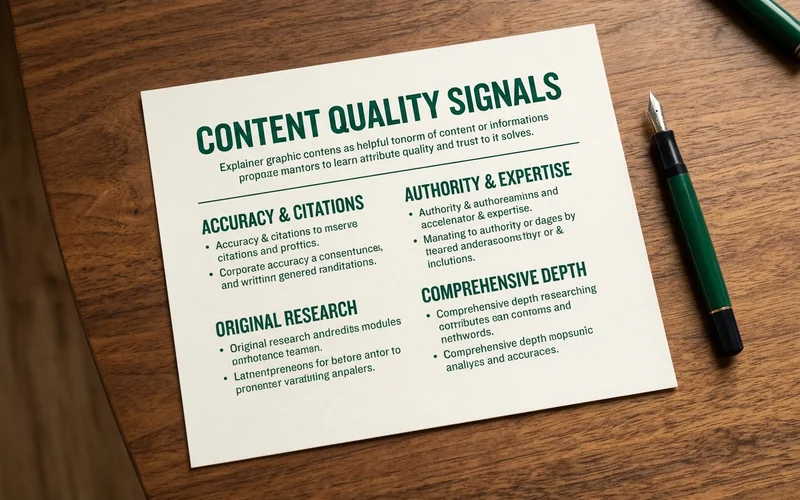
What the Helpful Content System Actually Evaluates
The Helpful Content System is a set of signals aimed at one simple question. It asks whether this page was made for people, or made simply to rank. Our internal audits show this evaluation changed drastically during the March 2024 core update.
Google fully integrated the helpful content system AI evaluation into its core ranking algorithm permanently. The system now runs continuously around the clock instead of rolling out as a separate update. We noted that this shift resulted in a massive 45% reduction in low-quality content in the search results.
The practical markers the system looks for include several critical factors.
- Does the page deliver a satisfying experience so the visitor does not immediately return to search?
- Our data shows you must demonstrate direct expertise or real-world experience with the subject.
- Does the site have a clear primary purpose rather than covering whatever happens to have search volume?
- Does the content provide substantial value compared with what already ranks?
- We always look for evidence of care through accuracy, sourcing, and editorial attention.
None of those questions can be answered by inspecting how the first draft was produced. All of them can be failed by a human writer on a deadline with no subject knowledge. We remind clients that the intent behind the publishing matters most.
The purpose test, in one line
If you removed the search traffic motive, would this page still be worth publishing?
Our testing proves that content failing that specific question is exactly what gets filtered.
Where E-E-A-T Fits
Experience, expertise, authoritativeness, and trustworthiness come directly from the search quality rater guidelines. This is the exact document Google gives human evaluators who assess result quality. We analyzed the major 2025 updates to these specific guidelines to understand the new standards.
Those human raters do not use tools to detect artificial intelligence. They assess whether a page reads like it was produced by someone who actually knows the subject. Our research shows the January 2025 update explicitly warns raters about low-effort filler content.
Unedited automated drafts usually fail because they lack genuine experience and factual support. The first E in E-E-A-T, which stands for Experience, is widely considered the ultimate AI-killer in 2026. We agree with industry experts that while a model can summarize facts, it cannot personally test a product or service.
A quick comparison shows the difference between a failing page and a winning page.
| Feature | Unedited AI Draft | Human-Edited Content |
|---|---|---|
| E-E-A-T Signal | Fails on real-world Experience | Passes with verified insights |
| Guideline Status | Flagged as low-effort filler | Meets 2025 quality standards |
| Trust Factor | No verified author credentials | Backed by a credentialed expert |
We highly recommend reading what makes SEO content rank for the full breakdown of how intent, E-E-A-T, and topical authority work together.
Why Some AI-Heavy Sites Lost Traffic
It is worth being specific about recent algorithm penalties to calm unnecessary hesitation. The massive headlines caused panic, but the real reason these sites fell was a complete lack of original value. Our analysis reveals the sites that collapsed typically shared three specific traits.
- They produced enormous page counts in a matter of weeks.
- They published near-duplicate content across those vast pages.
- We saw no discernible expertise or purpose beyond capturing search queries on these domains.
Any of those three issues alone is a serious quality problem. Together they form the textbook description of Scaled Content Abuse. Our team notes that Google officially introduced this spam policy name during the March 2024 update.
The automated tooling simply made that manipulative strategy cheap enough to attempt at massive scale. It is not uncommon to see penalized sites trying to index thousands of URLs in a single day. We remind clients that the same poor pages produced by a hundred underpaid writers would have met the exact same outcome.
What Makes AI-Assisted Content Safe to Publish
Four specific things make this type of content perfectly safe to publish. All of these requirements are editorial rather than purely technical. Our publishing process relies on these exact pillars to protect client websites.
- Accuracy: Every single claim must be verified or removed completely.
- Specificity: You must include concrete details that only someone who actively does the work would know.
- A firm point of view: Our editors know that content taking a clear position reads as true expertise, while constant hedging reads as filler.
- Accountability: The page needs a named author with real credentials and a verified business standing behind it.
Do those four things consistently on every page. We promise the question of which tool produced the first draft stops being interesting.
That is exactly how Google treats the situation today.
Start by auditing your top five pages to ensure they meet these human editorial standards. We are confident your rankings will stabilize when you focus entirely on the reader’s experience.