

You probably notice the same frustration I hear from business owners every week. The standard SEO metrics point everyone toward the exact same high-volume phrases. From what I have seen, relying purely on these traditional metrics is a fast track to blending in with your competitors.
A 2026 SparkToro study revealed that 68% of U.S. Google searches now end without a single click. This metric proves that high search volume means nothing if the platform answers the question before the user clicks.
Let’s explore a proven keyword research method that bypasses this zero-click trap. I will walk you through the exact steps to find low competition high intent keywords that bring ready-to-buy customers directly to your site.
This is how you beat the noise.
Start Where the Tools Don’t
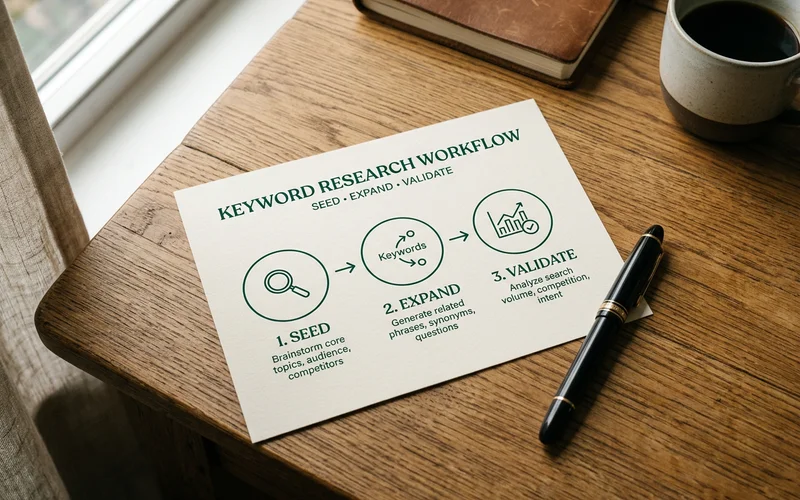
The most valuable search phrases come directly from your customers’ mouths, not from software dashboards. Start by gathering the exact questions prospects ask during sales calls or the specific objections they raise before booking a job. Our team at Content Geeks bridges the gap between scalable digital publishing and high-touch editorial quality by grounding our research in these real-world interactions. This raw customer data forms your seed list. Traditional software misses these nuances entirely.
You should write down twenty of these questions verbatim. Using the customer’s exact phrasing is the critical step most keyword research methods skip. We use this exact approach to make our niche keyword research service produce queries your competitors never see. It gives you a distinct advantage right out of the gate.
Step 1: Expand the Query Space
Multiplying your initial seed list by combining customer data with search engine features reveals the long-tail variations your buyers actually type. You need to take each seed question and widen it using four specific sources.
Leverage PAA Mining
PAA mining is your most powerful tool for discovering natural phrasing. Recent 2025 Semrush data shows that “People Also Ask” (PAA) boxes appear on roughly 90% of U.S. search results featuring AI Overviews.
Our specialists search the seed query, open each PAA box, and document the follow-up questions. Expanding one box generates several new ones automatically. Spending twenty minutes on a single seed usually yields thirty highly relevant questions.
Mine Google Search Console
Your existing website data offers a goldmine of quick wins. Export the queries your site already receives impressions for in Google Search Console to see what you almost rank for.
We filter this data specifically for positions 8 through 30. Google already considers your site relevant for these terms. A dedicated page targeting these specific phrases often wins top placement very quickly.
Configure Expansion Tools
Standard platforms are highly effective when you configure them to show the lowest search volume. You must switch off the minimum-volume filter in tools like the Semrush Keyword Magic Tool and Ahrefs Keyword Explorer.
Our strategy intentionally targets those zero-volume rows because they represent highly specific buyer needs rather than useless noise. Many lucrative niche phrases show zero volume simply because the tools lack enough historical data to measure them accurately.
Track Shifts with Google Trends
Google Trends and autocomplete help you catch seasonal fluctuations and sudden phrasing shifts. You can spot new search patterns emerging around recent local regulations or newly released products.
Step 2: Run Whitespace Analysis to Find Low Competition High Intent Keywords
Whitespace analysis involves manually reviewing page one of Google to spot weak, outdated, or mismatched content. Finding these gaps tells you exactly where you can rank quickly with minimal effort.
Look for one of these four situations:
| What you see | What it means |
|---|---|
| Forum threads and Reddit answers | Nobody authoritative has answered. Strong opening. |
| Pages that mention the topic but answer something else | Intent mismatch. A direct answer wins. |
| Thin pages, two paragraphs deep | Easy to beat with real depth. |
| Three comprehensive, well-sourced guides | Skip it, or find the sub-question they all skip. |
Seeing a forum rank is a massive green light for a business owner. Following Google’s “Hidden Gems” update, Reddit saw a 1,328% spike in U.S. search visibility. Our editors view these forum results as proof that searchers want specific, human answers but lack a professional source to trust.
That last row in the table matters most. Discipline about skipping saturated topics keeps your research list short and actionable.
Information gain is the deciding test.
If every ranking page repeats the same three points, the winning page is the one that adds a fourth. If you cannot name what you would add, do not write the page.
Step 3: Map Intent and Write the Brief
Assigning intent and planning the content structure ensures your page actually serves the reader’s goal. This prevents you from writing an educational blog post when the buyer really wants a commercial service page. Every surviving query gets four specific labels to guide the writing process.
- Intent type. Identify if the search is informational, commercial investigation, transactional, or navigational.
- Page type. Determine if this needs a hub page, a support page, or simply a new section inside an existing page.
- Angle. Decide if the content requires a definition, a comparison, cost details, a process breakdown, or a what-to-expect guide.
- The thing you add. Pinpoint the unique information gain that justifies publishing the page.
Your classified keyword list then transforms into a functional content brief. This document outlines the target query, secondary variations, heading structure, entities to cover, and required internal links.
Our team delivers the brief rather than a spreadsheet because raw data lists usually sit untouched in a drive folder. A clear brief gives your writers exact instructions to execute immediately.
Step 4: Prioritise by Proximity to Revenue
Sorting your targets by how close the searcher is to making a purchase guarantees a faster return on your content investment. A specific, problem-based search will always outrank a broad educational term on this priority list. You must rank the briefs by purchase intent rather than search volume.
Prioritizing intent provides several immediate advantages:
- Focuses resources on ready-to-buy customers.
- Reduces time wasted on high-traffic, zero-converting keywords.
- Accelerates the timeline for showing positive ROI.
Local businesses should always check the geo-modifier variants of each query. Adding a specific U.S. city or jurisdiction usually drops the competition to zero while simultaneously raising the buyer intent. Recent 2026 industry data shows that 28% of local searches result in a direct purchase. Our fastest-moving local pages are built entirely around these geo-modified terms.
If you want the exact deliverables and timeline for having this entire process handled for your business, read what to expect from a niche research order. Applying this complete keyword research method is the most reliable way to find low competition high intent keywords that actually drive revenue for your business.