

We hear the same frustration from US business owners every single week. You know how standard SEO advice always pushes you to chase massive, broad search phrases. That strategy rarely works for specialized local services or complex B2B products.
Our editorial team at Content Geeks often sees companies waste thousands of dollars fighting for generic traffic. The real value lies in unanswered niche keywords that your actual buyers are asking about right now.
This is a massive missed opportunity.
We are going to break down the mechanics behind zero search volume keywords. Let’s look at the data, what it actually tells us about buyer intent, and explore a few practical ways to respond.
The Definition
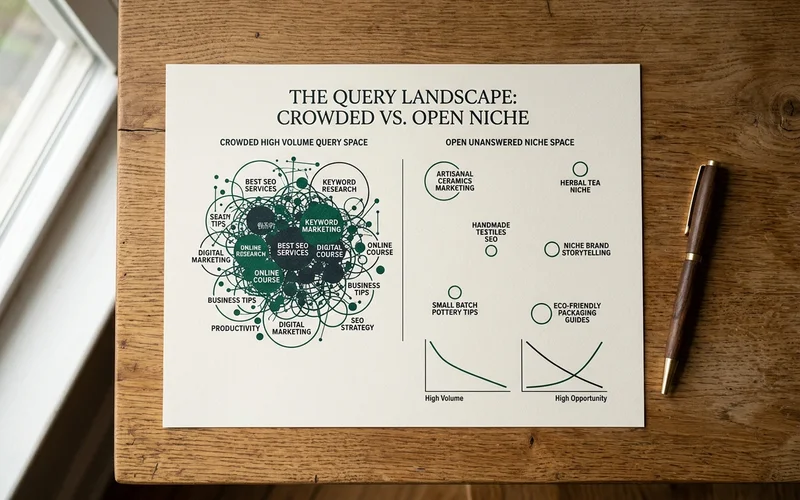
An unanswered niche keyword is a specific, high-intent search query that real customers type into Google. Almost nobody has written a good answer for it, causing it to report as a Zero-Search-Volume (ZSV) keyword in standard tracking tools.
We call this a massive blind spot for traditional marketers. These queries usually combine three elements: a situation, a service, and often a location or a constraint.
For example, our team looks for real-world queries just like these:
- “how to get permits for historic brownstone facade repair in brooklyn”
- “california clean fleet mandate exceptions for refrigerated transport”
- “pediatric dental sedation guidelines harris county tx”
Nobody is bidding on those specific phrases, and nobody has written a definitive page to capture that traffic. We know that somebody typing one of those strings is extremely close to hiring a professional. That specific gap is the whole basis of our unanswered niche keyword research.
Recent 2026 data from Ranktracker reveals that 94.74% of all search keywords receive 10 or fewer monthly searches. We see this exact pattern across every US industry we analyze. In fact, a 2026 Yotpo study confirms that long-tail keywords account for over 91% of all web searches, converting at a rate up to 36%.
Why Tools Report Zero
Standard keyword tools report zero volume because highly specific customer questions fall below their tracking thresholds. Software platforms simply cannot measure every conversational phrase a homeowner or business owner types into a search bar.
We want you to understand the three main mechanics behind this reporting failure. These technical limitations explain exactly why this lucrative opportunity persists today.
Search Volume Dispersion
People phrase the exact same need in dozens of different ways. Demand for one underlying question gets split across hundreds of long-tail query variations.
We observe that each individual string rounds down to zero, even though the aggregate demand is substantial. This fragmentation hides the true volume from automated reports.
Sampling and Rounding
Keyword tools model their volume estimates from clickstream samples and Google’s own bucketed data. Anything below a specific reporting floor shows as zero, a dash, or “not enough data.”
We know from recent industry audits that tools like Ahrefs and Semrush struggle with these low-volume queries. A 2026 analysis of over 300 million queries showed that standard software entirely filters out terms receiving fewer than 10 searches per month.
Recency
New state regulations, emerging products, and shifting local circumstances generate queries before any tool has data on them. Those brief reporting windows offer the easiest rankings available to a local business.
Our clients capture immediate market share by answering these questions early. By the time the search volume registers in a third-party tool, the space is already crowded.
The mental shift
Stop asking “how many people search this?” and start asking “how many people who search this need what I sell?” The second question is the one your revenue responds to.
Why Competitors Leave Them Unanswered
Competitors leave these profitable questions unanswered because standard agency workflows intentionally filter them out. Most marketing teams rely entirely on software metrics to dictate their strategy.
We see agencies completely ignore these terms, not because they are hard to rank for, but because they are hard to find. A standard keyword workflow follows a rigid, automated path:
- Starts with a third-party tool search.
- Applies a minimum volume filter.
- Sorts by a generic opportunity score.
Everything in the zsv keywords category is removed at the filter step. A human strategist never even sees the data.
There is also a massive incentive problem within the industry. Agencies report on total user sessions to justify their retainers.
We find that a page bringing 40 highly qualified visitors a month looks worse in a traffic chart than one bringing 4,000 unqualified ones. This remains true even when the smaller audience produces all the actual business enquiries.
Finally, answering these specific questions well requires deep business knowledge. You cannot invent the permit timeline for a historic facade from a basic SEO tool.
Our writers have to ask someone who has actually filed that paperwork in their city. This creates a high barrier to entry for lazy content marketers.
To make this choice clearer, consider the objective numbers:
| Metric | Standard Broad Keywords | Zero-Volume Niche Keywords |
|---|---|---|
| Average Conversion Rate | 1.5% to 3% | Up to 36% (Yotpo 2026 Data) |
| Traffic Volume | High (but heavily diluted) | Low (but highly qualified) |
| Competition Level | Extreme | Very Low |
| Business Expertise Required | Basic | Advanced / Practitioner Level |
Where They Come From
The highest-signal source for these keywords is not a software tool at all. The best data comes directly from your own sales and customer support conversations.
We constantly remind business owners that their inbox is an absolute goldmine. A true professional builds their initial strategy from actual customer interactions:
- Questions your team answers on the phone every week
- Objections raised during quoting
- Clarifications customers ask before booking
- The things people get wrong about your service
From that seed list, you can expand your reach using specific research techniques. We use People Also Ask (PAA) mining to discover related questions. A September 2026 report from AIxH shows that 97% of Google’s PAA answers are now generated by AI overviews, making this space critical for visibility.
Google Search Console query exports also provide incredible insights. Our favorite insider trick involves using a custom Regular Expression filter inside this platform. You can apply a specific string to your performance report to isolate questions.
Pro-Tip: The Question Filter Apply this exact Regex code in Search Console:
^(who|what|where|when|why|will|was|can|does|if|is|do|how|should|could|did). This instantly isolates every question keyword your US customers are currently searching.
Whitespace analysis then confirms if the currently ranking pages are thin, off-intent, or entirely absent. For the conversion logic behind targeting these terms, read why zero-volume keywords still convert. For the research method itself, see our guide on finding high-intent, low-competition queries.
We consider this the absolute best path to consistent lead generation. Start documenting the questions your customers ask today, and turn them into your most profitable website pages.