

Our team at Content Geeks bridges the gap between scalable digital publishing and high-touch editorial quality. When you evaluate niche keyword research vs high volume keywords, you have probably noticed that chasing the biggest search terms rarely translates to immediate revenue. This frustration is incredibly common for local business owners.
We see clients invest heavily in broad keywords, only to wait months for a single lead. A smarter approach flips that model entirely by focusing on specific, high-intent questions. Let us look at the data, what it actually tells us, and explore practical ways to respond.
The Two Strategies Side by Side: Niche Keyword Research vs High Volume Keywords
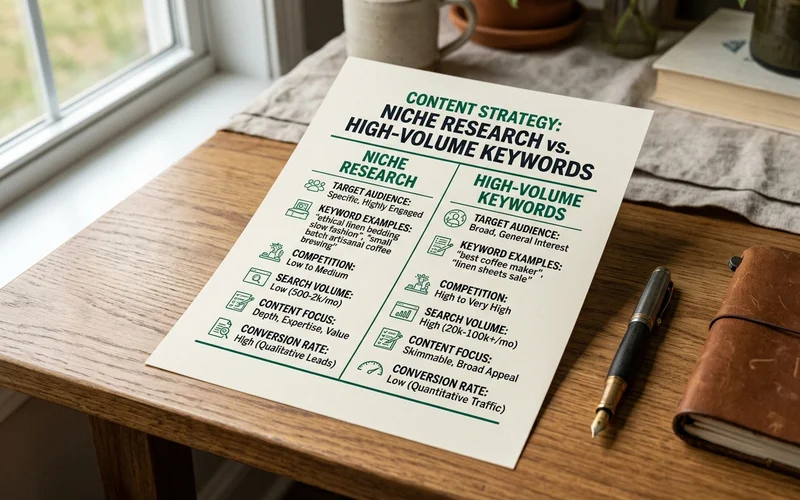
Unanswered niche research focuses on highly specific, low-volume queries that capture ready-to-buy customers, while traditional high-volume targeting chases broad terms that take months to rank. We find that the best choice depends entirely on your current domain authority, your available timeline, and whether you measure success by raw traffic or actual closed inquiries.
A massive 2026 analysis of 306 million US keywords by Ahrefs shows that 91.8% of all search queries qualify as long-tail or niche. This keyword strategy comparison highlights why highly specific searches are exactly how your customers look for help. Our unanswered niche research framework exists because most local businesses desperately need the fast payback these smaller queries provide. Yotpo’s latest 2026 report reveals that these long-tail keywords convert at up to 11 times the rate of broad, high-volume terms.
| High-volume targeting | Unanswered niche research | |
|---|---|---|
| Typical query | “content marketing services” | “how to write city pages without duplicate content” |
| Competition | National brands, established domains | Often nothing relevant |
| Time to rank | 12 to 24 months | 3 to 8 weeks |
| Visitor intent | Mixed, mostly researching | Specific, near-purchase |
| Conversion rate | Under 1% typical | 3 to 8% typical |
| Content volume needed | Large cluster plus link building | One good page per query |
| Budget profile | Front-loaded, slow payback | Incremental, fast payback |
| Risk | May never rank at all | Individual pages may attract few visits |
When High-Volume Targeting Makes Sense
High-volume targeting makes sense only when you already possess strong website authority, a massive marketing budget, and a long-term timeline for results. You should go after these massive head terms if your business can comfortably wait a year or more to see a return on investment.
We always ask clients to be brutally honest about three specific preconditions before committing to this route. A 2026 report from Search Engine Journal shows that complex head-term SEO campaigns frequently exceed $5,000 to $10,000 in monthly retainers. That level of investment requires serious stamina.
- You already rank for adjacent commercial terms. This specific signal indicates your domain can actually compete in a crowded space.
- You have a 12 to 24-month horizon and the budget to sustain it. Head-term campaigns do not produce immediate phone calls.
- You can support the massive content cluster. One single page will fail against established competitors, so you need a central hub and earned backlinks.
We frequently see a common mistake discussed on Reddit SEO forums where business owners try to force their products to fit high-volume keywords. This strategy usually fails because a three-year-old local site cannot beat national competitors who have accumulated a decade of trust signals. Targeting broad terms is a game won by established brands with massive, ongoing marketing budgets.
When Niche Research Wins
Niche research wins when you need immediate inquiries and have a specific local service area rather than a national market. This hyper-targeted approach is perfect for newer websites that need to demonstrate a fast return on their marketing spend.
Our team focuses on this strategy for the vast majority of local business owners we support. When analyzing long tail vs high volume queries, recent 2026 data from LowFruits shows that long-tail, niche queries average a massive 36% conversion rate. These exact conditions describe almost every successful campaign we launch:
- A newer or mid-authority website domain that needs quick traction.
- A pressing need for qualified customer inquiries this quarter, instead of next year.
- A clearly defined service area or specialism, like a specific neighborhood or unique trade skill.
- Customers who type specific, answerable questions into search engines before pulling out their credit cards.
If the low volume numbers still make you hesitate, why zero-volume keywords still drive qualified conversions covers why the search estimate is the least useful figure on the page.
- A budget that absolutely must demonstrate a clear return on investment before it can grow.
We have also noticed that generative tools like Google AI Overviews and ChatGPT heavily favor natural, multi-word questions. These platforms rely on specificity to provide accurate answers. This means targeting niche questions aligns perfectly with exactly how search behavior works in 2026.
The practical test
Search your main head term right now on Google. If the first page is filled with national brands and massive directories, you are not going to win that keyword this year. Spend your budget where you can win today, and let those victories build up to the head term as a natural byproduct.
Why Niche Suits Local Businesses Especially
Local businesses thrive on niche research because geographical modifiers instantly eliminate national competition. Adding a specific city or neighborhood to a search query completely changes the competitive landscape in your favor.
Our experience shows that a term like “emergency plumbing” is a brutally expensive national fight. In contrast, a phrase like “emergency plumbing for pre-war buildings in Somerville” is a specific question with roughly one plausible answer. That answer comes directly from somebody standing in their home with water pooling on the floor.
Average 2026 local SEO retainers sit around $500 to $1,500 a month for single-location businesses, according to ZapMinds. At that price point, focusing on high-intent niche queries maximizes your budget incredibly fast. We recommend a simple insider tip to find these golden phrases by checking where real residents complain and ask for help:
- Google Business Profile Q&A: Customers directly ask about your specific capabilities here.
- Nextdoor Community Boards: Neighbors constantly post highly specific local requests.
- Your Own Dispatch Logs: Your receptionists and technicians document the exact problems people call about.
Local businesses already possess the absolute best raw material for this exact research. Your estimators and technicians field these hyper-specific questions all day long on the job.
Pair this targeted niche research with local SEO content writing to create highly effective web pages. Each new page gets both the obscure query nobody else claimed and the rich local substance that makes your business credible.
The Sequence We Recommend
You should start by capturing easy niche wins to generate cash flow, and then use that revenue to fund a long-term head-term strategy. You do not have to pick just one approach forever.
Our prescribed order produces immediate revenue while you steadily build domain authority. A well-optimized niche page typically ranks within three to eight weeks. This rapid timeline generates the necessary cash flow to support the 12 to 24-month horizon required for competitive head terms.
We always advise tracking your early progress using a specific tool. Monitor your Google Search Console to track initial impressions on these new niche pages. Once an individual page hits a 10 percent click-through rate, your site has built the authority signals needed to start attacking the broader cluster.
- Quarter one: Build 8 to 12 niche pages covering the specific questions your buyers actually ask. Expect upward ranking movement within weeks.
- Quarter two: Complete the foundational cluster and add the main hub page targeting the broader commercial term.
- Quarter three onward: With topical depth established and actual client inquiries funding the work, a head-term attempt becomes highly realistic.
If you attempt this process in reverse, you will likely end up with a massive spreadsheet of invisible impressions. That backwards approach always leads to a very uncomfortable budget conversation with your marketing team.
We suggest taking a hard look at your current keyword strategy today. Identify three specific questions your customers asked this week, and start building your first niche pages around those exact phrases. Understanding the true difference between niche keyword research vs high volume keywords is what finally turns your website into a reliable revenue engine.