

The Arithmetic That Changes the Decision
Compare two pages a business could publish this month.
| Head-term page | Unanswered niche page | |
|---|---|---|
| Target query | “content marketing” | “how to write city pages without duplicate content” |
| Reported monthly volume | 40,000 | 0 |
| Realistic ranking timeline | 12 – 24 months, if ever | 3 – 8 weeks |
| Actual monthly visits at position 5 | 300 – 600 | 25 – 60 |
| Visitor state of mind | Browsing, researching | Has the exact problem now |
| Typical enquiry rate | Under 0.5% | 3 – 8% |
| Enquiries per month | 1 – 3, eventually | 1 – 4, quickly |
The niche page produces comparable enquiries, sooner, at a fraction of the effort. And it holds, because so few competitors will ever find the query. That is the arithmetic behind our unanswered niche keyword research.
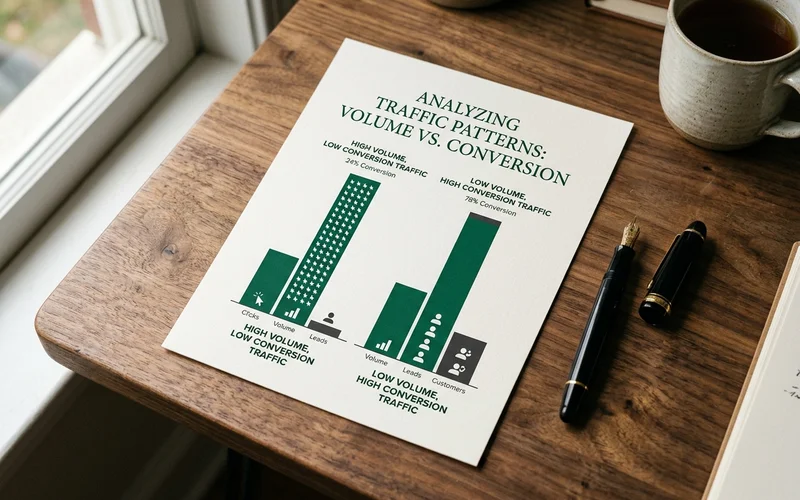
Why Specificity Raises Conversion
The longer and more specific a query, the further along the buying process the person typing it usually is.
Somebody searching “content marketing” might be a student, a competitor, or a marketing manager three months from a decision. Somebody searching “how to write city pages without duplicate content” has a live problem, a deadline, and probably a budget.
Specific queries also arrive with almost no competing answer. Instead of comparing your page against nine strong alternatives, the searcher finds one page that addresses their exact situation. Being the only satisfying result is worth more than being the fifth-best result on a popular term.
The compounding effect
Pages built on specific queries rarely get displaced, because the competitors who might displace them are still filtering these queries out of their keyword lists.
Worked Example
A regional restoration contractor had spent two years trying to rank for “water damage restoration” against national franchises. Nothing moved.
We built eleven pages on questions their estimators answered weekly, including a page on insurance documentation requirements for a specific state and another on the drying timeline for a common local building type.
None of those queries reported volume. Within six weeks, seven pages were ranking in the top three. Within a quarter they produced more qualified enquiries per month than the head-term campaign had produced in two years, because everybody landing on them already had water in a building.
The Risk of Volume-Only Targeting
Three failure modes show up repeatedly.
Nothing ranks. New or mid-authority domains cannot outrank established competitors on head terms, so the entire budget produces impressions and no positions.
The traffic does not convert. Broad queries attract broad audiences. Sessions rise, enquiries do not, and content gets blamed for a targeting problem.
Reporting drifts from revenue. Once traffic is the metric, the work optimizes for traffic. That is how businesses end up with impressive analytics and a quiet phone.
A useful correction is to report enquiries per page rather than sessions per page for a quarter. The ranking of your content by that metric tends to look very different, and it usually favours the specific pages.
For the strategic comparison of both approaches, read niche research vs. high-volume keyword targeting.